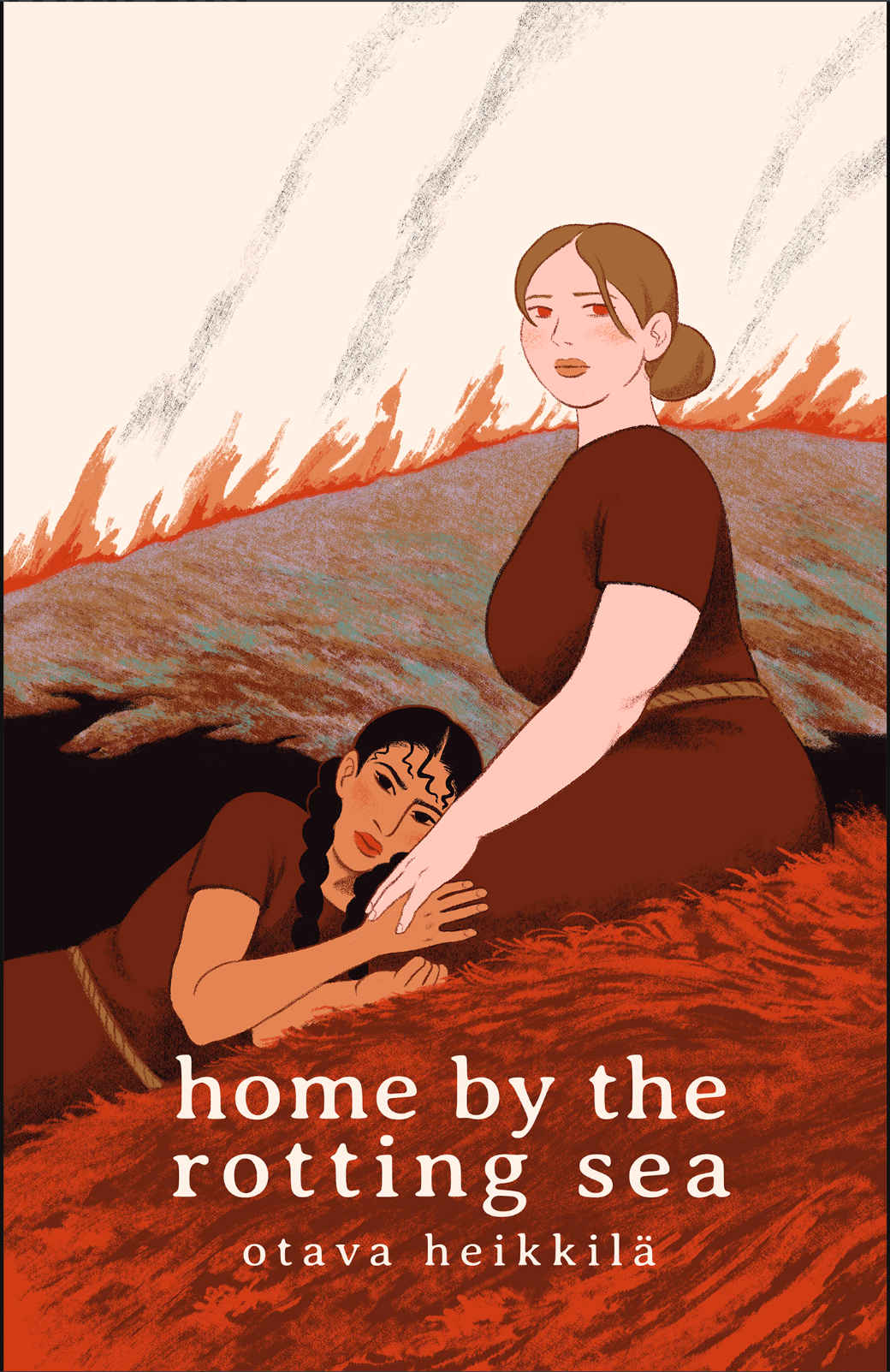
I first found out about Home By the Rotting Sea as a member of the Cartoonist Co-op, when buzz started happening around the Ignatz Award nominations. One of the comics nominated was Home By the Rotting Sea by Octava Heikkilä, a comic originally released during ShortBox Comics Fair 2024. I asked for a copy of the comic to review, which Octava Heikkilä graciously provided (thank you!).
If you have never heard of this comic before, here’s the listing from the itch.io page:
“The Väki are giants, and much loathed and feared by us humans. When territorial tensions threaten to break out, the Human King sends an envoy of riches, and two members of his harem, Ilta and Laulu, as gifts for the Väki.
Stranded from their kin and home, the two human brides must find a new way of living among the scarred strangers.”
What follows is 96 pages of stunningly drawn comics. From an art standpoint, I adore the dynamic page layouts. The brush textures that make the colors feel somewhere between colored pencil and dry-brushed acrylics are also fantastic.
The art works seamlessly with the narration and story, which follows the point of view of Ilta, one of the brides sent as a “peace offering” to the Väki. I didn’t know what tone the story would take at first, but it does open with tension as these women are sent to a people they have only heard terrible things about.
The pacing features carefully-paced panels depicting Ilta and Laulu’s slow integration into the community of the Väki. And it is slow. Especially since at the start, the Väki tell the brides (and the audience) that they have no concept of “wives.” Instead they are referred to and treated as “gifts.” Something new but fragile.
As a reader, I appreciated the slow pace of it all. There is time to be absorbed in the textures of the art, the world it depicted, and the characters walking (and eventually dancing and marching) through it. There is also plenty of exploration of gender in this story, from the genderqueer depictions of the giants to the brides confronting their expectations of their roles.
A Word of Warning
That said, there is an instance of sexual assault (that’s not depicted any further than initial contact). The thought-provoking material was how the Väki handled the retribution. Because there are consequences wrought on the one who committed the assault. This narrative explores the consequences as well as the aftermath.
I will not spoil the ending (it’s only 96 pages). But I will say that it fits the tone of the story. An ambiguous story needed an ambiguous ending, which Home By the Rotting Sea achieved. This story is still sitting with me even a week after I’ve finished reading it.
If you would like to give it a read, you can get the comic from the artist at Small Press Expo this weekend! Or you can get it on the creator’s itch.io page.
That’s all for now. Now go read some comics!
Thank you for reading.
You. Are. Awesome.