Prepare! For The Legend of Jamie Roberts, Volume 1 on KickStarter…

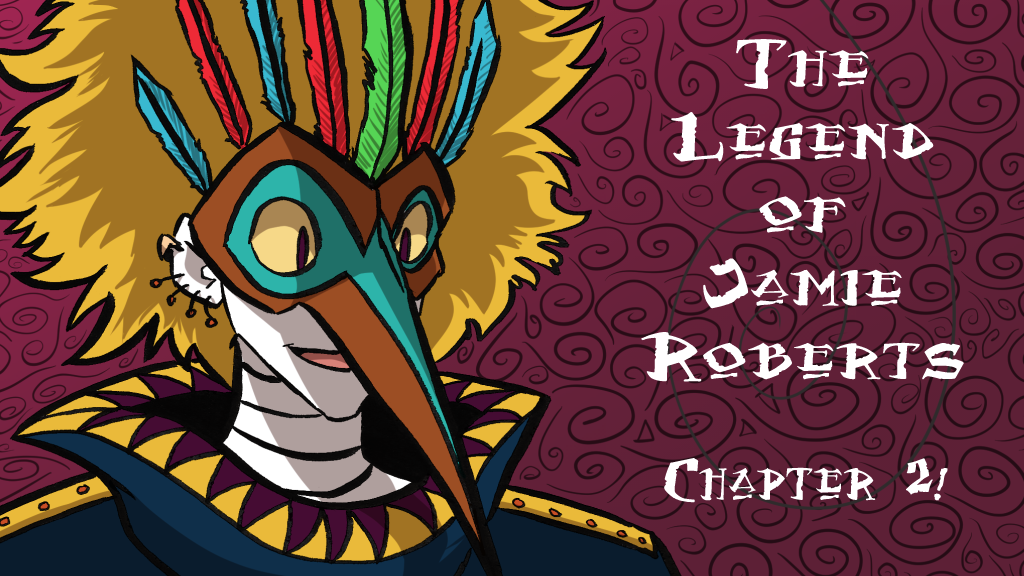
jamie roberts, a genderqueer human with messy blonde hair and green eyes, is gesturing with dreamy excitement against a brown background.

It’s that time – time for a new KickStarter campaign. And this time, I’m hoping to get The Legend of Jamie Roberts, volume 1 in paperback.

The WHAT

The Legend of Jamie Roberts is a weekly webcomic I write and illustrate. It’s all about Jamie – neither man or woman, but a PIRATE. Jamie and their two best friends, Thomas and Daniel, find an unfinished map for a land they never explored. And so together, they go on a new adventure!

Volume 1 will collect the first 4 chapters of the webcomic. Yeah, I know I had chapters 1 and 2 in single-issue comics before. And those had their own KickStarter campaigns. But volume 1 will be the first time the first 4 chapters of the story will be in print together.

The WHEN

Mark your calendars – the KickStarter will launch before the end of February.

The HOW

If you want to be first in line to pre-order the book, you need to get on the email newsletter. My email peeps are the first to know when ANY KickStarter launches. That means they get to see the Early Access rewards, which are only available for a limited time.

Any questions? Hit me up in the comments below.

Thanks for reading!

You. Are. Awesome.

We Need to Support Black Creators Working in Comics

Y’all. I wanted to make a blog post about my favorite comics by black creators. Until I realized I know so few of them.

First, I’ll say that C. Spike Trotman and Taneka Stotts are my favorite black creators who have edited for the Beyond anthologies and My Monster Boyfriend (among other works). And yes, both ladies have written and drawn great comics of their own!

But very few comics I read are written and illustrated by black creators.

At least, not artists working recently.

I have a soft spot in my heart for Jackie Ormes and Richard “Grass” Green. Look up their work, they are AWESOME.

That said, I can do better to support black comics creators working today. I will do my part to seek them out and read their work. (I think I’ll start with Prince of Cats by Ronald Wimberly, because I follow him on Instagram.) (And also this list from Book Riot.)

Part of the reason why I think it’s hard to find comics by black creators is because…well…

Here’s the Secret.

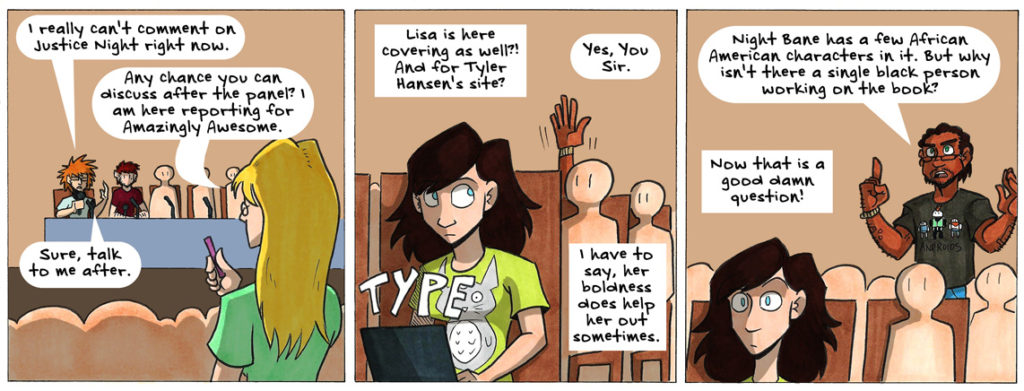
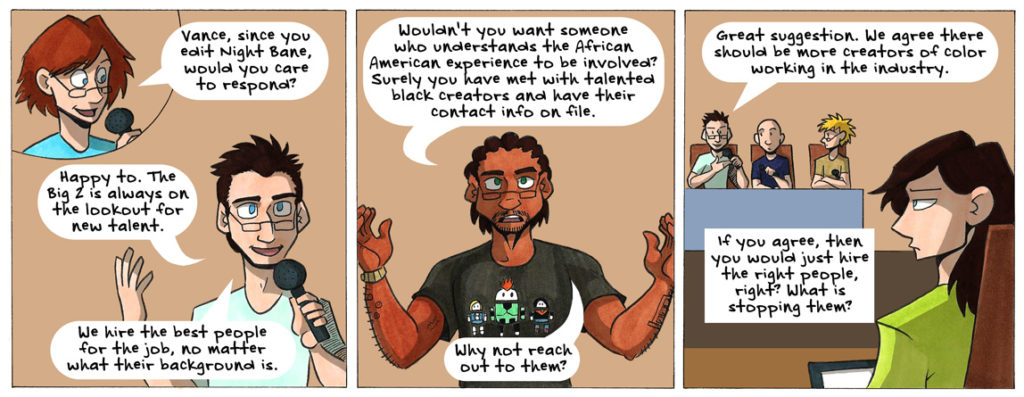
It’s an uphill battle to HAVE black creators working in comics, particularly “mainstream” comics. They want to work, but industry leaders and execs will not hire them. This prejudice in hiring practices is so intense that CB and I wrote about it in Validation a long while ago, and the topics discussed in that arc are STILL relevant today. (The strips at the top of this post are some highlights from that arc.)

There are more black creators in indie comics because until recently, no one in “mainstream” comics wanted to hire them. Often for not-great reasons.

But then, I’ve never been a big supporter of “mainstream” comics. It was an all-white-boys club in the 80s and 90s, and in so many ways, it still is. “Mainstream” comics regard minority groups as subject matter to highlight their “otherness,” not as a target audience to make comics for.

I know that opinion is contentious. But I’ve come to this conclusion after making comics and attending conventions over the last 7 years. I’ve seen and heard the arguments all around. And I could write a whole other blog post about “the industry,” but that’s for another day.

Long story short: “mainstream” comics has a representation problem with hiring black creators. So much so that many black creators go indie and have immense success on KickStarter.

Am I going to let “mainstream” comics’ allergies to hiring black creators get in the way of seeking them out? No. I will go find a creator on KickStarter, do my research, and if their story tickles my fancy, SUPPORT THEM. And I hope you do the same.

And if you missed it, here’s a list of some of my favorite black creators. Some of them DO make comics in the indie sphere.

That’s all for now. Thank you for reading!

You. Are. Awesome.

How I’ve Run 11 Successful KickStarter Campaigns

Hold on to your seats, because I’m about to reveal how I have run 11 Successful KickStarter campaigns.

And unlike some folks, who put these kinds of secrets behind a pay wall, I’m sharing this learning for free in today’s post.

I started running campaigns specifically for comics way back in 2013. And I’ve averaged 2 or 3 campaigns per year since.

Now, here’s the thing: if you’re looking to raise millions of dollars, these tips COULD still help you. But keep in mind these things…

The most I have raised in one campaign is a little over $2,000, for Validation’s Final Push. This is still 419% of the asking goal. That said, I HAVE run one campaign that raised 800% over the asking goal.

How did I do it? Well here are my tips:

Know your BARE MINIMUM that you need to make a project happen.

Do the math. Factor in costs to print, shipping orders, KickStarter and credit card fees. Add up anything that could cost you money for the project. Know the bare minimum amount that you need to make your project come to life.

This is NOT the time for bells and whistles. If you’re raising funding to get a book printed, know the minimum you need to get JUST the book printed. And ONLY the book.

Often when I see first-time KickStarter campaigns launch, the asking goals are $3k or more – and yet the audience for it cannot raise that much.

And the asking goal is set so high so often because the math is just inaccurate. Because these folks ignore the next point…

Set the rewards to be easy on the budget – and related to the project.

Most of my campaigns are to get a specific product printed. Usually a book. So my rewards are copies of the book, MORE copies of the book, other books I have excess stock of, and something easy I can fulfill with little cost to make. Like commissions!

Often, when I see an unsuccessful KickStarter – and yes, this includes one failed campaign I have under my belt – the campaign fails because of one thing… The rewards offered cost extra to make. And the creator tries to tack on the cost of making those extra rewards onto the overall asking goal.

So for example: a creator may only need $600 to get a book to print…but they think “I could offer stickers! I’ll offer 3 different designs!” But those stickers cost an extra $500 to print. So they add it up and ask for $1100 on the campaign as the initial goal. But wait, there’s t-shirts they wanna make! And those cost $500 more to print, so they add it on and –

You see where this is going. Eventually there are so many rewards offered that the creator THINKS are essential. But they are stretch goals.

Offer stretch goals for after your bare minimum is met.

Stretch goals are goals to make when your campaign raises extra money past the initial asking goal.

Stretch goals are THE THING TO USE when you have extra products you could make, but are not considered essential to make it happen.

For example: if you want to get a book printed, stickers and T-shirts are NOT essential to make it happen. Make those your stretch goals.

Whether you succeed or not – POST. UPDATES.

I’m speaking here as both someone with successful campaigns AND as someone who has backed other campaigns. A creator who posts updates on the KickStarter page, before AND after the campaign ends, is a good creator.

I can count on one hand the number of people I have backed on KickStarter who have not posted updates. And those are the same number of people I would not support again if they launched another campaign.

Posting updates, even irregularly scheduled ones, is still better than dropping off the face of the earth.

And yes – you need to post these updates on the KickStarter page. There’s a link in the creator menu called “Post Update.” USE THAT FEATURE.

Updates can be little things or big things. Just keep your backers in the loop regarding the progress of the project they helped you launch.

Hopefully, with these tips, you can launch your own successful KickStarter, and make your project happen. I believe in you.

If you have any other questions, leave a comment below!

That’s all for now. Thank you for reading!

You. Are. Awesome.
Things I (Re)Learned in Promoting My KickStarter Campaign

By the way, The Legend of Jamie Roberts, Chapter 2’s KickStarter IS STILL GOING. You have until 11:59 pm EST on Feb 21 to back this project.

Not gonna lie – I’ve had 11 successful KickStarter campaigns. Once you’ve had so much success, you fall into a rhythm.

But I HAVE had one KickStarter campaign fail. I learned a lot from that failure, which makes it true that you learn more from your failures than your successes. Because when you’re successful, you develop a groove.

The thing about grooves, though, is that it’s easy to get comfortable inside of those grooves. It’s like when you walk in circles in the dirt – after a while, there’s an obvious path of where you’ve tread.

And if you want to grow, you have to take a step outside of that dirt circle.

I’ve re-learned a few things in promoting the KickStarter for The Legend of Jamie Roberts, Chapter 2 (which is STILL GOING until Feb 21 at 11:59 pm EST). Here’s what I’ve re-learned:

Make Use of Empty Space on Your Blog Sites

Ever since the demise of Project Wonderful, I’ve written off the power of ad spots on blog sites and webcomic sites. It’s easy to write it off, since it can be difficult to make money from posting ads in this era of ad-blockers.

Yet the original reason these became ads were to signal-boost SOMETHING. Someone wanted their product known, so they made a promotional image and paid someone to post it.

Well, I don’t (yet) have a network of peeps to reach out to and ask about posting an ad on their site and paying them for it.

But I DO have sites of my own. Sites for Johnson & Sir, Charlie & Clow, The Legend of Jamie Roberts, and THIS site. AND I have space on these sites that isn’t used yet.

So I made a button to promote the KickStarter, posted it on the sites, and VOILA – insta-ad. I’m still getting traffic on these sites, so the ad spots are seen by the peeps who go to these sites.

Reach Out to Folks Who Are Adjacent To What You Do

I have to thank Jamie (no relation to Jamie Roberts) for this one. I had almost written off this particular tactic.

The Legend of Jamie Roberts is about a genderqueer pirate. So Jamie (no relation) suggested I reach out to LGBTQ centers, and ask for their help promoting this KickStarter campaign. He sent me a list of LGBTQ centers in Ohio (which you can find here). This resource includes contact information for these sites.

I also had a flier for another LGBTQ center, from when I went to Flaming River Con. (One of the few positive things to come out of that show). So I reached out to this center, as well.

All told, I reached out to 5 or so of these centers, and only heard back from 1: the center whom I had a flier for. I think it helped that the contact spoke with me at the show, so they had a face to connect to the email.

So while perhaps blind contacting doesn’t work – what DOES help is keeping your rolodex of peeps you meet at comicons, festivals, and other shows. Reach out to those who are adjacent to what you do and ask if they can help signal-boost you.

Don’t Underestimate the Power of Fliers

I made a flier for my local comic shop to promote my KickStarter campaign. Then I sent it shortly after launch. I asked if they could print up copies and set them with their other fliers, and make a social media post, as well. And they agreed to help (I’m very fortunate that the folks at my local comic shop are cool dudes).

I DID notice that a few days after I did that, the number of backers and money raised went up a good 20-25%. Pretty dang good!

So don’t underestimate the power of fliers. Share them with comic shops. They’re usually more than happy to help indie comic creators succeed. If not? Find someone else who’d be happy to share your flier.

Those are what I’ve re-learned in promoting a KickStarter campaign into success. Next time I’ll make a post about how to run a successful campaign. I just realized I don’t have a post about that (yet).

Thank you for reading!

You. Are. Awesome.