This was originally given as a talk at a local Unitarian Universalist congregation. Parts of it have been edited to better adapt to being a blog post.
This will also have mentions of AI, as well as discussions of violent content and descriptions of waste. Reader discretion is advised.
–
I have now read this book, Braiding Sweetgrass by Robin Wall Kimmerer, twice. And both times, two stories stood out to me, both tackling the same root theme:
The Thanksgiving Address, and the Wendigo.
The Thanksgiving Address is in a chapter where the author discusses a practice common among Native American groups in the New York state region. In this practice, before any official business or school can be conducted, the people all give the Thanksgiving Address, a multi-part address, with each part narrated by a different speaker, in which the people thank specific attributes of nature for their gifts. “We thank the water for quenching our thirst and giving us life; We thank the birds for gifting us song and watching over us in the skies,” etc. The address doesn’t just have thanks – it’s also a statement of accepting responsibility. For humans are the only species aware of, and with the ability to take, our responsibility to be stewards of the water, the earth, and the Earth’s creatures. “We thank the water for quenching our thirst and giving us life. May we endeavor to keep the waters clean for our nonhuman siblings who drink from the same waters as us.”
This isn’t a one-sided “master over the elements” relationship. It’s a reciprocal one. Over and over, throughout the book, Robin Wall Kimmerer stresses that the relationship we humans have with nature is a reciprocal one. If we treat our gardens well, then there will be berries and wild things. If we tear down our trees, then we are left with barren rocks. If we poison our water, we will have none to drink and neither will the salamanders or the birds. But if we clean up our water, then we will have salamanders and fish and birds again.
The Thanksgiving Address stood out to me as an organized practice of gratitude among a collective of people. This is unheard of, especially given that we live in a society whose central tenant is this: “For all the wealth it professes to make, the central tenant of the market economy is that there is scarcity.” That’s a direct quote from the book, but it’s true – we live in a society that pushes scarcity on all of us. And when you live in a scarcity mindset, you more often than not look at relationships in a transactional way. “What can you do for me? My time and energy is limited. If you cannot give me something in return, then I’m not sticking around.”
Whereas, if you are raised in the Thanksgiving Address and the ideas such a practice supports, you start to think, “Well gosh, I’m glad we have birds in the sky, and water to drink and earth to grow our fruits and veggies with. There is abundance all around me. I need to take care of it, or else it will disappear.” This may sound like it’s still a reciprocal relationship, but here’s the truth – even if humans disappeared overnight, water will still flow, birds will still sing, flowers will still grow and the Earth will keep going. Life. Goes. On. That doesn’t absolve us from the responsibility of being mindful of what we do. There are segments of the book dedicated to the Honorable Harvest, which includes the practice of not taking the first thing you see, of leaving the last of a thing behind, of giving a gift to nature before you harvest something. The Honorable Harvest as a practice is about stewarding the harvest so that you’re not the only one benefiting from it.
To elaborate on that further, I have to bring up the other story that stood out to me in this book: The Wendigo.
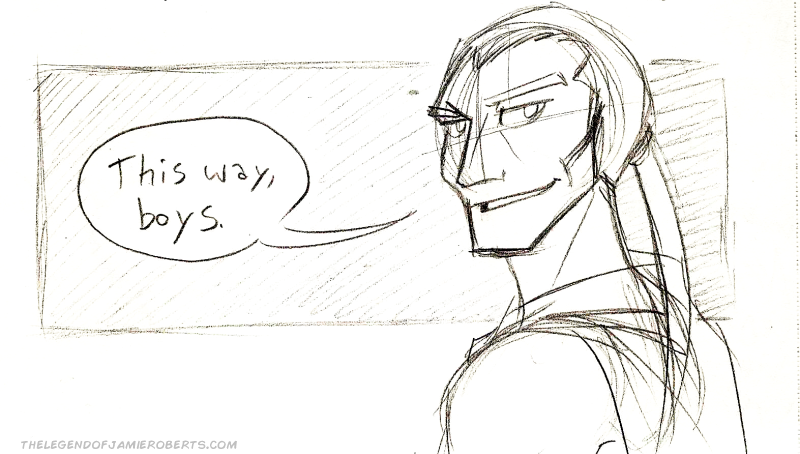
My apologies to the Indigenous listeners in the audience, because Wendigo as a concept is not something to be taken lightly. Too often, Wendigo is treated as a monster-of-the-week in movies, games, and comics. I’m not immune from this. I made a whole comic in 2016 about people hunting a Wendigo that got loose on Halloween night. But if I had known in 2016 what I know now, I would have written that comic very differently.
There are variations of the Wendigo story and how it’s told, but the core of the story goes something like this:
A human, in winter, ordered their brother to go hunting in the woods and bring back food. The brother comes back with food, but the human is never satisfied, demanding more and more food. Eventually, the human eats their brother. This turns the human into the Wendigo, a monster cursed with eternal hunger who can never be satisfied. The Wendigo can sound like a human, but it’s always mimicry – the Wendigo’s goal is always to keep eating until there is nothing left.
White people are sometimes told that this story is a cautionary tale about cannibalism in winter. The truth is this story came about in Indigenous communities as a commentary around capitalism. Capitalism is a system that encourages Wendigo behavior – monsters who were once people, demanding more and more, never satisfied even when there is nothing left to harvest.
Combating Wendigo behavior is a multi-prong strategy: it’s resisting it in summer, when there is abundance everywhere. It’s expressing gratitude for what you have been given. It’s taking responsibility for your actions and partaking in the Honorable Harvest. It’s never taking more than you need because there are nonhuman creatures that also rely on the water and the earth.
But there was one question that came up several times in the Intersectional Reading Group regarding Wendigo. “How do you stop Wendigo behavior in other people?”
I thought about it, and to answer that question, I want to dovetail the conversation again, specifically into discussions of “AI”.
“AI” is a label a lot of tech bros and billionaires are slapping onto everything, from large language models (or LLMs) to Photoshop (which, for the record, is not AI. Tech bros love slapping the label of “AI” onto things that are not actually AI because they want to paint the picture that it’s inevitable and you cannot resist it).
The other truth about “AI” is that the term is specific to LLMs and image generation programs that are “trained” by feeding the software data. And much of that data fed into the software is literature, art, illustrations, personal information, and other creations made by people. Did the tech bros ask for permission from the artists, the writers, and the people? No. Tech bros stole it. All of it. There is a reason many artists are against AI, and most of the argument comes down to “stop using my art without my permission, you talentless hacks trying to pretend to be artists without doing the work of actually learning to draw. I know you are doing this to cash in on being perceived as an artist without actually doing the work. Stop profiting off of my work and learn to draw yourselves.” And credit where credit is due – there are people who learned to draw because these LLMs and image generators could not capture what it was they were trying to do. And once they learned to draw, they loved it and stopped using the programs. But the programs are still around, because it’s easier for some people to pretend to be artists by theft.
“AI” is also “trained” by “curators.” These “curators”, as was revealed by investigative journalists, are actually laborers in places like Kenya and Uganda, who are forced to scan the worst content on the internet to “train” the AI into recognizing what is violent or pornographic. The content they are forced to see is so awful that many who take the jobs quit within a year and have to get treatments for post-traumatic stress disorder. But tech bros don’t want you, the average person, to know that’s how “AI” gets “refined”. Tech bros want to paint the picture that “AI” can “train itself.” It cannot. It relies on the labor of people, who are chewed up – eaten alive, you may say.
In Braiding Sweetgrass, Robin Wall Kimmerer writes a story about what she would do if she encountered Wendigo. And her strategy is to make a pot of buckthorn soup. And when Wendigo bursts down her door and demands to be fed, she feeds it the buckthorn soup. From the book, “A small dose of buckthorn is a laxative. A strong dose is a purgative, and a whole kettle, an emetic. It is Windigo nature: he wanted every last drop. So now he is vomiting up coins and coal slurry, clumps of sawdust from my woods, clots of tar sand, and the little bones of birds. He spews Solvay waste, gags on an entire oil slick. When he’s done, his stomach continues to heave but all that comes up is the thin liquid of loneliness.”
Artists, writers, and programmers online have found a few different ways to stop “AI” LLMs and image generators. One of the best, but riskiest, ways to do it is to “poison” the programs. One can do this by feeding specially-coded images into the programs, and setting up Markov text generator programs that catch the “AI” software and forces it into nonsensical text rabbit holes. These make it so that the “AI” programs are unable to “generate” anything. Or if they can generate anything, anything the “AI” programs spit out is gross, nonsensical, and useless.
It’s not just poisoning the Wendigo. It’s also treating anything that Wendigo touches as poison. In regards to AI, I have some good news, though I have to give some context.
The Eisners are an award ceremony in the field of comics. Named after Will Eisner, who was a master with ink brush and was one of the first artists to treat comics seriously as an art form, the Eisner Awards are highly regarded in comics. Think of it like the Oscars, but for comics. And within the last month, the Eisners dropped someone from consideration for the awards because their submission used “AI”.
It’s not just awards ceremonies that are banning “AI generated works.” Art expos, gallery shows, calls for submissions into magazines and publications, festivals, and more places are updating their policies to say “no AI generated work will be accepted.” These organizers do not want the poison in their wells. They have found the Wendigos, and the poison they are vomiting.
But what about the Wendigo who was once human? Is there a way to bring them back to humanity?
In Robin Wall Kimmerer’s telling of how she would encounter the Wendigo, she continues. She tells us that after Wendigo is poisoned from the buckthorn soup, she will go back and get a healing tea. She reassures it that this new tea is not poison. It’s a mix of strawberries, maple, silverbells, and other herbs that inspire connection, gratitude, and healing. She says, “There is just one more part of the medicine. I am no longer afraid. I sit down beside him on the newly greening grass. “Let me tell you a story,” I say as the ice melts away. “She fell like a maple seed, pirouetting from the autumn sky.”” And tells the story of Sky Woman, a story about human and animal working together to build Turtle Island.
Tech bros and their ilk are, fundamentally, lonely. They can have 14 children and billions of followers on social media, and still not know love. All they know is how to take and take. They have not been shown how to express gratitude or thanks. They do not know the work it takes to make art, or make the flowers grow, or sing the song of praise.
Let us sing our songs, dance our dances, make our art, grow our flowers and berries and herbs, and share all of these with each other. Let us give our Thanksgiving addresses. Robin Wall Kimmerer teaches that this is how we defeat Wendigo behavior – we build our communities. We take care of each other, including our nonhuman kin. If Wendigo wants to shed their skin, leave behind their poison, and join us, they can – but they have to put in the work.
It takes work to build our communities and be good stewards of the land and water. But Nature rewards those who put in the effort. And that reward is love.